Stephen Hawking
✶January 8, 1942
†March 14, 2018
United Kingdom
About their life
About their life…Where candles were lit from
3 candles from 2 countries
Memories
Would you like to keep memories of someone else?

✶January 8, 1942
†March 14, 2018
United Kingdom
3 candles from 2 countries
Would you like to keep memories of someone else?
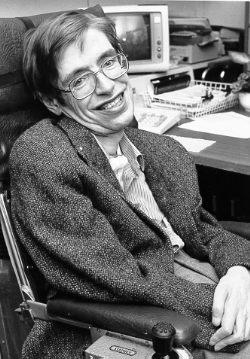
Stephen William Hawking was born in Oxford, England, in 1942. He studied physics at Oxford and moved to Cambridge for doctoral research in cosmology. At the age of 21 he was diagnosed with motor neurone disease and given only a few years to live, yet he continued his work with remarkable determination, gradually losing mobility but never his intellectual drive.
Hawking's research illuminated the deepest questions of the cosmos. With Roger Penrose he showed how singularities arise in general relativity, and in 1974 he demonstrated that black holes should emit radiation, a result now known as Hawking radiation. In 1979 he was appointed Lucasian Professor of Mathematics at Cambridge, the chair once held by Isaac Newton, a post he occupied for three decades.
In 1988 he published A Brief History of Time, which sold millions of copies and made cosmology a subject of dinner-table conversation. Communicating through a speech synthesizer, he lectured worldwide and became one of the most recognizable scientists of his era. He died in 2018, and his ashes were interred in Westminster Abbey near Newton and Darwin, a fitting place in the story of science.
Cosmologist who transformed the study of black holes and, despite decades of motor neurone disease, brought the wonders of the universe to millions of readers.
Biography from the article Stephen Hawking on the English Wikipedia, available under CC BY-SA 4.0.